Spring
A Moveable FeastSpring in A Moveable Feast is a fragile renewal rather than a simple promise of happiness. Its return transforms the city and gives ordinary mornings a sense of possibility, but cold rain can seem to threaten the season itself. Set against that seasonal cycle, the narrator’s later unease exposes a contrast at the heart of the book: Paris can feel newly generous in spring, while life within it remains difficult to resolve.
The River and the Seasonal Cycle
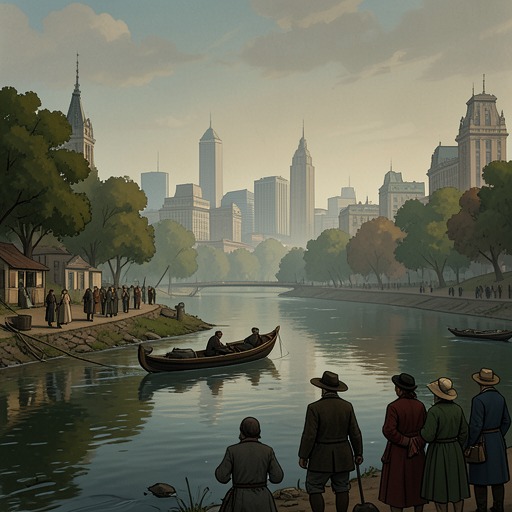
The Seine gives the narrator a daily view of a city whose working life continues through the seasons. Fishermen pursue serious, productive fishing in Paris, contrary to travel writers who treat them as foolish men who catch nothing. Many have small pensions, not yet made worthless by inflation, or fish on days and half-days away from work. Their catches are modest: a few fritures to take home to their families. The narrator lacks fishing tackle and saves his money to fish in Spain; because he cannot know when work will end or when he must leave, he also avoids becoming bound to fishing’s good and slack periods. Even so, following the river’s fishing life interests him and makes him glad that families can be fed by it.
The riverbank is more than a view. Barges have their own life aboard, while tugs fold back their smokestacks to pass beneath bridges as they pull their tows. Elms grow along the stone banks, with plane trees and, in some places, poplars. In this company of people, boats, and trees, the narrator says he could never be lonely beside the river. The setting makes seasonal change visible: spring’s arrival can be watched day by day among the trees, while the river’s eventual flow after freezing offers a second image of return.
Spring’s Arrival and Its Threat
The narrator expects autumn to be sad. Falling leaves, bare branches, wind, and wintry light make the season’s loss familiar, as though part of each person dies with the trees. Spring’s failure would be different. When heavy cold rains beat back the new season, it can seem that spring will never come and that a season of life is being lost. The narrator calls this the only truly sad time in Paris because it feels unnatural: the expected cycle has been interrupted.
The comparison gives a failed spring the force of an unjust death. The return of the river after a freeze is expected, as is the eventual arrival of spring; when persistent rain seems to kill it, the narrator imagines the loss as that of a young person who has died for no reason. In those days spring always came at last, but the possibility that it might not arrive was frightening. The chapter heading A False Spring preserves that tension: the season can appear to offer renewal while remaining vulnerable to reversal.
A Morning Made of Small Encounters
When spring comes, even when it is false, the narrator sees no problem except deciding where to be happiest. A day seems without limits if he can avoid making engagements. People, by contrast, usually limit happiness; only a very few seem as good as spring itself. The reflection gives the season a social as well as natural meaning: its openness is precious partly because human arrangements can narrow it.
On spring mornings the narrator works early while his wife sleeps. The windows stand open; rain-wet cobbles and the sun drying the houses facing the window mark the change in weather, while the shops remain shuttered. A goatherd comes up the street playing pipes. A woman from the floor above brings out a large pot, and he milks one of the heavy-bagged black goats into it. His dog pushes the other goats onto the sidewalk; they turn their necks as they look around. After the woman pays and the goatherd moves on, the dog herds the goats ahead, their horns bobbing. The woman returns upstairs with the milk in her pot. She is the only customer for goat milk in the building. The narrator then goes back to writing, with the woman’s felt-soled cleaning shoes and breathing audible as she pauses outside their door before entering her own apartment.
The morning’s ordinary business briefly competes with work. The narrator goes down to buy a racing paper, noting that even the poorest quarter has at least one copy and that on a morning like this it must be bought early. He finds one on Rue Descartes, at the corner of Place de la Contrescarpe. The goats are going down Rue Descartes; he breathes the air and walks back quickly to climb the stairs and finish his work. He is tempted to follow the herd down the early street, but returns to the paper first. It reports that the races are at Enghien racecourse, a small, pretty track associated with outsiders. The scene joins the season’s freedom to a working day: the goats offer an invitation to linger, while the racing paper and unfinished writing draw him back to routine.
Renewal Beside Unresolved Feeling
The spring morning later stands in contrast to a night whose unease survives its apparent comforts. After a meal at Michaud’s, hunger is no longer a problem, yet the feeling that had resembled hunger while the narrator and his wife were on a bridge remains on the bus home, in their room, and after they go to bed. When he wakes with moonlight on the roofs, the feeling is still there. He turns his face from the light into shadow but cannot sleep; his wife has also woken twice and is now sleeping. The narrator remembers how simple life had seemed that morning, with the false spring, the goatherd’s pipes, and the racing paper.
That remembered morning does not explain away the night’s uncertainty. Instead, it sharpens the difference between spring’s apparent ease and the complexity of the lives unfolding within it. Paris is old; the narrator and his wife are young; and poverty, sudden money, moonlight, right and wrong, and the presence of another person remain difficult to make simple. Spring therefore carries both delight and limitation. It renews the city, but it cannot resolve the feeling that persists after hunger has been satisfied, or guarantee that the happiness of an open day will last.